PhilosophyMonkeyFranzKafka

  • Subscribe to our RSS feed.
  • Twitter
  • StumbleUpon
  • Reddit
  • Facebook
  • Digg
Showing posts with label Einstein. Show all posts

Monday, 13 August 2012

Einstein Mask Optical Illusion

Posted on 07:15 by Unknown
In our everyday experience, it seems as though perception is simply a matter of information hitting your sense organs and going straight to our brain. In reality, however, perception turns out to be an incredibly sophisticated and complex concatenation of various brain modules actively trying to interpret and synthesize the disparate information sent by the different senses. The reason perception may seem to be a passive phenomenon is that it's effortless, but that doesn't mean that there's not a hell of a lot of stuff going on in the brain. It just means that our brains have evolved to do all this amazing work without making us consciously aware of what it's doing.

But how do we know that perception is an active process of interpretation, synthesis and recognition? Well, a great place to start would be the lessons we get from the study of optical illusions, such as the following spooky Einstein illusion because even if you understand why you experience the illusion, you can't not experience it. Feel your brain fooling you:


For a great introduction to perception and optical illusions, check out Beau Lotto's TEDTalk.
Read More
Posted in Einstein, Optical illusion, Stephen Fry | No comments

Friday, 20 July 2012

Philosophy of Time

Posted on 08:19 by Unknown
Sorry about the sparse entries lately. My mind has been busy with a bunch of personal stuff.

So today is the release of the last installment of The Dark Knight series, so I figured you're probably looking for some sort of light-minded stimulation to deal with the inevitable boredom, and I thought to myself, why not have a little introduction to the philosophy of time? It's precisely the kind of subject that makes a summer Friday go by all the more quickly :p


Obviously, this is a bit old, and just barely scratches the surface of this topic, but I hope you can see that time presents all sorts of interesting and paradoxical questions for which we don't yet have a fully satisfactory understanding. That opens up the possibility that maybe you'll be the person to figure it all out one day, so get to work! :)
Read More
Posted in Einstein, philosophy, physics, time | No comments

Friday, 25 May 2012

Brian Greene - Why Is Our Universe Fined-Tuned for Life?

Posted on 04:07 by Unknown
Have you noticed that wherever Brian Greene goes, computer animations go with him? Well, this TEDTalk presentation is no exception :) I'm starting to wonder whether this might be the physicist equivalent of a comfort blanket...

In any case, and as you may expect if you're familiar with him, he lays down the case for string theory, and explains some of the fascinating implications if string theory and the cosmological theory of inflation were true. Even as mere hypothetical possibilities, these ideas merit our attention.

What I do have a major problem with, however, is his "explanation" for why our universe is fine-tuned for life. It's a version of the anthropic principle that is either completely backwards or completely question-begging (circular)... or both... I'll let you be the judge:


The analogy with our distance to the sun doesn't quite work because, despite his explicit claim to the contrary, it's asking one question but answering another. Our distance to the sun doesn't explain why Earth is  x-number of miles away from the sun (see what I mean by circular?). It doesn't tell us anything about astronomy or physics.

What it explains is why we live on Earth and get to ask that question, but it tells us nothing about the conditions that led to our planet being where it is... Similarly, the fact that we happen to inhabit the particular kind of universe that contains the conditions that allow for life-forms such as ours tells us nothing about why this particular universe happens to have those particular features.

In other words, you can't answer the question of why is our universe fine-tuned for life by answering that it's because our universe is fine-tuned for life... or am I missing something here?
Read More
Posted in Einstein, Elegant Universe, logic, physics, TEDTalks | No comments

Tuesday, 10 April 2012

Standing on the Shoulders of Giants

Posted on 07:18 by Unknown
This famous phrase, made famous by Sir Isaac Newton, and celebrated ever since, may have been a public attempt at modesty and historical gratitude that was sure to endear him to, and inspire, subsequent generations of natural philosophers, but it may also have been a little bit of an underhanded insult to Robert Hooke, just the kind of thing Newton would do when his gigantic and fragile ego was wounded if anyone dared to question some of his ideas...

Still, the phrase has taken on a life of its own, and it is now used to describe the incredible scientific and technological progress that has taken humanity to the unique position of being able to question its own origin and place in the universe, and to actually start to answer those questions, change its environment, make its dreams more ambitious and then make those dreams come true. The following captivating video is a beautiful celebration of the cumulative knowledge and insight we've gained about ourselves and the universe in only a few centuries, and the amazing feats we've accomplished as a result, by standing on the shoulders of giants:


Hope you're inspired!
Read More
Posted in animation, Einstein, Elegant Universe, Galileo, history, Kant, Newton, science, space | No comments

Wednesday, 4 April 2012

The Fabric of the Cosmos - The Illusion of Time

Posted on 10:21 by Unknown
In the first episode of the Fabric of the Cosmos series, we learned a little bit about the weirdness of space, so hopefully that massaged your brain enough for something even weirder: time.

Philosophers and scientists have been trying to understand what time is since antiquity, and one thing that they have found is that it's incredibly difficult to say anything about time without already presupposing it in some sort of viciously circular argument. Nevertheless, curiosity drives us to ask questions that we then have to test by conceptual analysis and by empirical means, and we often find out that these come in conflict with each other in ways that elude simple solutions.

There are philosophical accounts of time (and I'll provide a short introduction soon), as well as scientific accounts, most of which are based to various extents on some of the incredible insights to come out of Einstein's theories of special and general relativity.

So fasten your seat-belts as Brian Greene takes us on a tour to understand some of the deepest of mysteries: What is time? Does the past exist? Does the future? Can we change the future? Can we travel back in time? If so, can we change the course of history? And hey, if you can go back in time and meet your former self, which one is really you? That last one is more of a philosophical question, just to show you how badass we are :)


If your head isn't spinning by now, then you might want to get yourself checked into a hospital :)

And if you want to watch the original from NOVA, here it is:


Watch The Fabric of the Cosmos: The Illusion of Time on PBS. See more from NOVA.

Read More
Posted in documentary, Einstein, Elegant Universe, Newton, philosophy, physics, time | No comments

Monday, 5 March 2012

The Fabric of the Cosmos - What Is Space?

Posted on 07:30 by Unknown
That's probably not the first question that comes to mind for most people when they wake up in the morning, but it is definitely one that has kept some of the greatest minds of all time awake at night. What exactly is space? Is it a substance? Is it merely a relationship between objects? Whatever it is, is it static or dynamic, absolute or relative, immanent or transcendent? If there no physical objects in the universe, would empty space still exist, or is that an incoherent question, like asking what happened before the beginning of time? Join Brian Greene in a fascinating (if gimmicky) exploration of one of the most fundamental scientific and philosophical questions in this first episode of The Fabric of the Cosmos:


And in case the youtube video stops working at some point, here's the original from NOVA:


Watch The Fabric of the Cosmos: What Is Space? on PBS. See more from NOVA.

For more related videos, check out the Elegant Universe Tag.
Read More
Posted in documentary, Einstein, Elegant Universe, Large Hadron Collider, Newton, physics, science | No comments

Thursday, 23 February 2012

Faster Than the Speed of Light?

Posted on 10:05 by Unknown
Some months ago, news broke indicating that scientific measurements in Italy had determined that some neutrinos could travel faster than the speed of light. The media jumped on the hype bandwagon and declared the "death of Einstein's theory of relativity." Physicists (aka, the experts on these questions) were skeptical because ALL previous experimental and observational data, including neutrinos and light traveling from super nova explosions really really far away and reaching Earth at exactly the same time, confirmed Einstein's predictions, so they concluded there must have been some error in the measurement, the analysis, the equipment, etc. on which the Italians relied. Of course, there were also cultural reasons for doubt: as Sergio Bertolucci, research director at CERN indicated, "I have difficulty to believe it, because nothing in Italy arrives ahead of time." :)

News are starting to pop up everywhere now that there was indeed a glitch in the equipment. Still, whatever the real answer turns out to be, and since everyone seems to be paying attention to the story, this presents a great opportunity to learn some fundamental lessons not only about relativity and other ground-breaking research in theoretical physics and cosmology, but how science itself works and makes the tremendous progress it does, so let's watch this delightful documentary narrated by Professor Marcus du Sautoy:


Sometimes I do wonder whether these physicists are insane in the mem-brane :)
Read More
Posted in documentary, Einstein, Elegant Universe, Large Hadron Collider, math, physics | No comments

Friday, 3 February 2012

A Brief History of Mathematical Geniuses

Posted on 07:51 by Unknown
Math, unfortunately, is usually taught, and consequently thought of, as a set of cold, bloodless tools to solve practical and theoretical problems that are somehow removed from real lived experience.

However, the truth of the matter is that math has a fascinating and mesmerizing life of its own, and those who have really confronted its secrets have found it to be a source of love, respect, admiration, inspiration, despair, confusion and wonder. Whatever else it may be, math is not boring... not if you actually pay attention.

In the following set of short documentaries, which you should definitely share with your mathophobe friends, Professor Marcus du Sautoy explores the lives, the insights, the contributions and the influence of some of history's greatest mathematicians.

Newton and Leibniz:
     

Leonard Euler:
     

Joseph Fourier:
     

Evariste Galois:
     

Carl Friedrich Gauss:
     

The Mathematicians who helped Einstein:
     

Georg Cantor:
     

Henri Poincare:
     

Hardy and Ramanujan:
     

Nicolas Bourbaki:


What other mathematicians would you have included in this list?

And for a touching and fascinating biography/tribute to Cantor, don't forget to check out the spectacular documentary Dangerous Knowledge.
Read More
Posted in audio, biography, documentary, Einstein, history, Leibniz, math, Newton | No comments

Tuesday, 31 January 2012

The Twin Paradox

Posted on 08:00 by Unknown
If you're riding a train and you shoot a gun in the same direction, the total speed of the bullet, relative to the ground, would be the speed of the bullet relative to the gun plus the speed of the train relative to the ground. There's nothing mysterious about that concept.

But what if you decided to shoot your photon torpedo gun (aka, your flashlight, or your torch if you're in England or Australia) under the same conditions? Intuitively, you'd think the speed of the light leaving the flashlight would equal its speed relative to the flashlight plus the speed of the train train relative to the ground, except you'd be wrong.

At the end of the 19th century, and especially thanks to the work of James Clerk Maxwell, there was plenty of evidence to conclude that the speed of light is constant, no matter how fast or in what direction you move relative to it, but no one could understand how this could possibly be so... until Albert Einstein developed his special theory of relativity with an intuition would that would forever revolutionize our understanding of physics: while the speed of light is constant, time and space are relative.

One of the weird consequences of that idea has come to be known as the twin paradox, about which you get to learn in the following funny animation:


Actually, GPS is one of the few applications that combines both special and general relativity in order to work because the Earth's gravitational pull also messes with the curvature of space-time.
Read More
Posted in 3-minute philosophy, 60 Second Adventures in Thought, animation, Einstein, physics | No comments

Tuesday, 7 June 2011

Everything and Nothing - Everything

Posted on 07:21 by Unknown
You may find this hard to believe, but we've known about the true size of the universe for only about 100 years. When Copernicus proposed his revolutionary heliocentric model, for instance, he still believed in the existence of a perfect celestial sphere where all the stars revolved around the sun in a perfect circle. That belief would be slowly chipped away with the observation of a Super-Nova explosion in 1572.

It wasn't until the 1920's when Edwin Hubble, thanks to a brilliant idea proposed by Henrietta Swan Leavitt, was able to measure the distance to a Cepheid variable in what was suspected to be either a weird part of the Milky Way, or an altogether different galaxy. The measurements made it clear that the universe was orders of magnitude larger than we had suspected.

Could it, in fact, be infinite? Does space go on forever? Or does it have to have an edge? If it has an edge, what's on the other side? More universe? And if it's infinite, and there are an infinite number of stars, why isn't the night sky as bright as it is during the day?
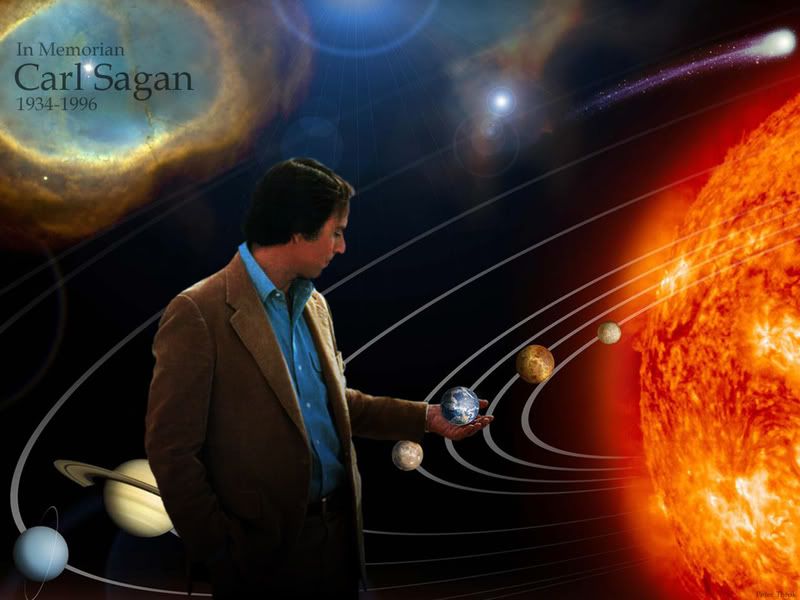
In the following documentary, Professor Jim Al-Khalili traces the history and the science behind these and other similarly fascinating questions that scientists, especially with the help of brilliant minds like Gauss, Reimann and Einstein, are just beginning to solve.


I would have thought that a finite amount of stars would solve the problem much more easily, but maybe Professor Al-Khalili hasn't heard of Ockham's Razor? :)
Read More
Posted in chemistry, documentary, Einstein, Elegant Universe, history, Jim Al-Khalili, math, physics, science, space | No comments

Monday, 13 December 2010

Cosmos: Travels in Space and Time

Posted on 07:20 by Unknown
Continuing his exploration of the Cosmos, Carl Sagan takes us today on an exploration of interstellar and time travel, the likes of which no human being has ever actually experienced so far.

In order to explain this idea, and after giving a quick lesson on constellations, he goes to the Tuscany area of Italy (home of Leonardo da Vinci and childhood residence of Albert Einstein), and conducts some thought experiments in order to illustrate the strange consequences and apparent paradoxes of Einstein's theory of special relativity.

With a basic understanding of the physics involved, Sagan then turns his attention to the possibility of future travel to other stars and galaxies. Although this is a sound theoretical possibility, the engineering required to make this a reality is still nowhere in the foreseeable future yet, but scientists are already coming up with ideas about how to get started...


Check out the rest of Carl Sagan's Cosmos.
.
Read More
Posted in Carl Sagan, Cosmos, documentary, Einstein, evolution, Leonardo da Vinci, physics, space, time | No comments
Older Posts Home
Subscribe to: Posts (Atom)

Popular Posts

  • Report: U.S. Kids Get Majority of Antibiotics from McDonald's
    And here we've been complaining about our lack of a healthcare system that attends to the medical needs of the poor:) Check out more hil...
  • Election Results in a Beautiful Animation
    I don't know if you heard, but here in the ol' U.S. of A. we just had an election this Tuesday. You know, just trying to choose who ...
  • Unhate
    Contrary to what the majority of people all over the world believe, I'm pretty sure this is the only life we will ever know. To some, th...
  • Peter Singer vs. Don Marquis - Abortion Debate
    Outside of philosophical circles, I'm sorry to say, arguments concerning the issue of abortion, for and against it, usually take place w...
  • What Is Evolution and Natural Selection?
    I don't know if it's by design or circumstance, but (apart from the religious and ideological elements) part of the resistance to ev...
  • Christopher Hitchens - Philosophy and Booze
    If you're familiar with the late Christopher Hitchens, you probably know that besides being a prolific writer, social commentator, publi...
  • Daniel Dennett - How to Tell If You're an Atheist
    The human mind is both beautiful and frustrating. We have minds that can contemplate the meaning of infinity and consciousness, on the one h...
  • What Is the Self?
    If you're not used to thinking philosophically, here's a bit of a conceptual conundrum for you: you have certain personal and profes...
  • Cameron Diaz Flirts with Sir David Attenborough
    If you've been spoiled by multiple BBC documentaries narrated by Sir David Attenborough, as I have, then you've probably experience...
  • Ring of Fire Eclipse Moon Shadows
    I've always loved (and been curious about) how leaves distort the path of light waves. If I were to speculate, I would guess that maybe ...

Categories

  • 3-minute philosophy (11)
  • 60 Second Adventures in Thought (8)
  • Alan Turing (3)
  • All Too Human (1)
  • amazing (6)
  • animals (25)
  • animation (77)
  • anthropology (4)
  • architecture (2)
  • Aristotle (13)
  • art (14)
  • atheism (41)
  • audio (21)
  • autism (2)
  • Ayaan Hirsi Ali (1)
  • Big Brother (4)
  • biography (9)
  • Bishop Berkeley (3)
  • Brainspotting (3)
  • Brian Cox (6)
  • Bryan Magee (1)
  • Carl Sagan (5)
  • Charles Darwin (9)
  • chemistry (6)
  • Christopher Hitchens (6)
  • cognitive science (5)
  • corruption (108)
  • Cosmos (3)
  • creationism (12)
  • Dan Ariely (1)
  • Daniel Dennett (4)
  • David Attenborough (3)
  • David Chalmers (1)
  • David Hume (17)
  • David Sloan Wilson (2)
  • debate (12)
  • Descartes (11)
  • dinosaurs (1)
  • documentary (45)
  • doodling in math (6)
  • E.O. Wilson (2)
  • economics (23)
  • education (43)
  • Einstein (11)
  • Elegant Universe (11)
  • Enemies of Reason (21)
  • environment (19)
  • Epicurus / Lucretius (1)
  • ethics (100)
  • evolution (55)
  • existentialism (13)
  • feminism (13)
  • Flying Spaghetti Monster (2)
  • Founding Fathers (13)
  • free speech (4)
  • free will (7)
  • Freud (1)
  • funny songs (12)
  • Galileo (6)
  • gay stuff (12)
  • geography (9)
  • George Carlin (2)
  • health (35)
  • Hegel (1)
  • Heidegger (1)
  • hilarious (163)
  • history (64)
  • Hobbes (8)
  • Inside Nature's Giants (6)
  • Jane Goodall (1)
  • Jim Al-Khalili (4)
  • John Locke (9)
  • John Searle (4)
  • Jon Stewart (48)
  • jurisprudence (8)
  • Kant (7)
  • Ken Miller (1)
  • Kierkegaard (2)
  • Kurt Vonnegut (1)
  • Large Hadron Collider (7)
  • Leibniz (5)
  • Leonardo da Vinci (1)
  • linguistics (11)
  • literature (25)
  • logic (60)
  • Lord Robert Winston (1)
  • magic (3)
  • Malcolm Gladwell (1)
  • Martin Luther King Jr. (2)
  • Marx (2)
  • Masters of Philosophy (19)
  • math (38)
  • Michael Faraday (2)
  • Michael Sandel (2)
  • Michael Shermer (1)
  • mind (34)
  • Mind control (1)
  • monkeys (8)
  • Monty Python (3)
  • movie (2)
  • music (7)
  • National Geographic (3)
  • Neil DeGrasse Tyson (7)
  • Newton (7)
  • Nietzsche (7)
  • Optical illusion (10)
  • Paradox (8)
  • Penn and Teller (1)
  • personal (5)
  • Peter Millican (10)
  • Peter Singer (7)
  • philosophy (111)
  • Philosophy: A Guide to Happiness (1)
  • physics (39)
  • Plato (7)
  • porn (7)
  • privacy (4)
  • problem of evil (4)
  • psychology (18)
  • public announcement (2)
  • racism (19)
  • religion (115)
  • Richard Dawkins (12)
  • Richard Feynman (7)
  • Ricky Gervais (1)
  • Robert Krulwich (1)
  • RSA Animate (16)
  • Sam Harris (3)
  • sartre (1)
  • science (79)
  • sex (19)
  • SNL (2)
  • Socrates (7)
  • space (32)
  • sports (4)
  • Stephen Colbert (40)
  • Stephen Fry (6)
  • Stephen Hawking (4)
  • Stephen J. Gould (1)
  • Steven Pinker (6)
  • Steven Weinberg (1)
  • technology (20)
  • TEDTalks (50)
  • The Human Sexes (4)
  • The Onion (24)
  • Tim Minchin (4)
  • time (5)
  • time lapse (10)
  • William Lane Craig (3)
  • Wittgenstein (3)

Blog Archive

  • ▼  2013 (49)
    • ▼  August (1)
      • The Terrors of Sleep Paralysis
    • ►  July (9)
    • ►  June (9)
    • ►  May (8)
    • ►  April (8)
    • ►  March (6)
    • ►  February (3)
    • ►  January (5)
  • ►  2012 (205)
    • ►  December (4)
    • ►  November (7)
    • ►  October (12)
    • ►  September (14)
    • ►  August (15)
    • ►  July (20)
    • ►  June (19)
    • ►  May (27)
    • ►  April (26)
    • ►  March (19)
    • ►  February (22)
    • ►  January (20)
  • ►  2011 (217)
    • ►  December (19)
    • ►  November (20)
    • ►  October (17)
    • ►  September (19)
    • ►  August (16)
    • ►  July (19)
    • ►  June (15)
    • ►  May (19)
    • ►  April (16)
    • ►  March (22)
    • ►  February (19)
    • ►  January (16)
  • ►  2010 (29)
    • ►  December (26)
    • ►  November (3)
Powered by Blogger.

About Me

Unknown
View my complete profile