PhilosophyMonkeyFranzKafka

  • Subscribe to our RSS feed.
  • Twitter
  • StumbleUpon
  • Reddit
  • Facebook
  • Digg
Showing posts with label technology. Show all posts

Thursday, 6 June 2013

Hunters Are Pussies

Posted on 06:56 by Unknown
There, I said it. You have probably seen what hunters like to do, right? Once they've killed some "game," they like to take pictures of themselves next to the dead carcass before mounting it as a trophy on their walls for the world to see and admire. Future generations are going to think of us the way we think today about slave owners: as a bunch of ignorant assholes...

But here's the thing: this wasn't a fair fight. In fact, it wasn't a fight at all. The poor animal got ambushed and killed before it could have any time to protect itself, and the wimpy but boastful "predator" was hundreds of yards away, taking comfortable advantage of a weapon that makes him feel like a "man" while simultaneously negating that manhood by placing him completely outside of any real danger and discomfort.

And as Stephen Colbert reports, to add insult to injury, they're also getting lazier...


The Colbert Report
Get More: Colbert Report Full Episodes,Indecision Political Humor,Video Archive

If you want to hunt and be a real man, leave your rifle behind, grab a couple of knives and go fight the beast head-on. Let the best fighter win...

But let's keep it real, here's what's probably going to happen:


Q.E.D.
Read More
Posted in ethics, hilarious, Stephen Colbert, technology | No comments

Wednesday, 10 April 2013

Ken Jennings - Watson, Jeopardy and Me

Posted on 07:50 by Unknown
During the industrial revolution, much of the manual labor that had hitherto been done by people was suddenly taken over by machines, who were faster, more accurate, cheaper, and didn't complain about safe working conditions, fair wages, paid sick days, maternity leave, holiday pay and so on, so they replaced people, who ended up losing their jobs.

Well, that's physical labor, we laughed, and thought that machines could never replace our raw brain power: we know how to think, how to reason, how to solve problems, how to calculate and compute, etc. Well, guess what? As Watson, the powerful IBM supercomputer proved a couple of years ago, you might not want to feel so confident that you have job security just because your job requires mental power... the machines are coming, and unlike the terminator who was shooting for John and Sarah Connor, these machines are shooting for your job!

In the following TEDTalks presentation, Ken Jennings, all-star Jeopardy champion, tells the story of his experience of being the best Jeopardy player of all time and getting beaten by a computer, and reflects on what this might mean for the future of humanity.


How long until your job is taken over by a computer?
Read More
Posted in education, mind, technology, TEDTalks | No comments

Wednesday, 8 August 2012

Quit Your Technology Job and Get a Ph.D. in the Humanities

Posted on 08:38 by Unknown
As a student of philosophy, and as someone who has chosen to dedicate his life to the pursuit and sharing of wisdom, you might call me biased, but I really believe that the world would be a better place (intellectually, morally, politically, culturally, scientifically, aesthetically, etc.) if we had more philosophy in our lives.

And I'm not alone in this position. If you remember Damon Horowitz (from one of the best TEDTalks of all time), he's the philosopher-in-residence at Google, doing some groundbreaking work with them in a way that most technologists wouldn't be able to. And he manages to do this, he claims, because the humanities have taught him profound valuable lessons about cognition, language, humanity, meaning, and all the aspects relevant to the human condition that go far beyond what mainstream courses in computer programming and artificial intelligence could ever possibly imagine.

So, in the following presentation delivered at Stanford University, Horowitz makes a very compelling case for the importance of pursuing a higher level of education in the humanities


And if you're a little more practically-minded, there's still every reason to pursue a higher education degree in philosophy, even if you end up doing something else. Philosophy will give you the kind of training that will make you stand out from the crowd and create something great and valuable.
Read More
Posted in literature, philosophy, technology | No comments

Wednesday, 23 May 2012

Manuel Lima - The Power of Networks

Posted on 05:26 by Unknown
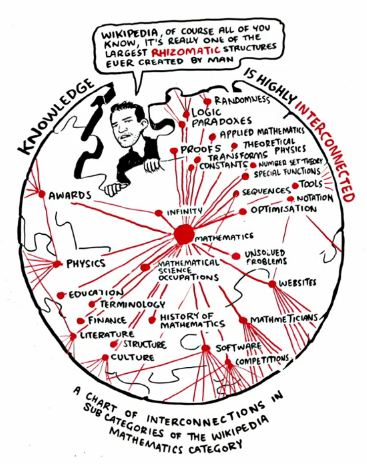
The art and science of formal classification owes its origin to the great philosopher Aristotle, who conceived of a conceptual tree whose trunk and branches denote different divisions of ontology, hierarchies of being, logical and natural relations, etc. This tree metaphor became ubiquitous until very recently. It's been used to map historical and genealogical changes and hierarchies among subjects ranging from family blood lines to languages, the history of religious evolution, biological taxonomies, scientific branches, corporate maps, etc. Darwin, of course, famously used such a tree to explain his idea of common ancestry.

Helpful as it's been, and given current levels of computational power, the traditional genealogical tree may no longer be the most useful took for mapping out various sorts of relationships. In the following fascinating RSA Animate presentation, Manuel Lima explores the power of network visualization.


That blithely romanticized ending didn't quite do it for me, but the entire presentation did get me thinking about the mathematical explanatory power of fractals...
Read More
Posted in Charles Darwin, evolution, history, psychology, RSA Animate, science, technology | No comments

Friday, 16 March 2012

Synthetic Biology - Playing God?

Posted on 07:49 by Unknown
Whenever new technologies arise, such as the ability to genetically engineer biological organisms, one of the classic luddite objections is that such novelty represents human hubris as we attempt to "play God" and do something "unnatural." I've never quite understood such objections, since we run the risk of "creating life" whenever we have a few too many at the local pub and we happen to find an equally hammered partner with whom to engage in all kinds of unnatural acts. True story :)

Still, there is something to be said for the risk of unintended consequences, especially as 21st century advances in science and technology, not to mention their democratization and cheap and easy access, have the potential to produce dangers against which evolution has never had to fight. Some of these innovations are probably inevitable, so while we might not always be able to stop them, we might want to become acquainted with them so we can then start to think about how to manage and regulate them. And to introduce some of these advances, here is Adam Rutherford as he explores some of the truly state-of-the-art advances that synthetic biology is producing, starting with the spider-goat:


Unless by "playing God" people mean that he's the only one allowed to wipe most of life out of the face of the Earth...


There was an interesting interview in The Atlantic recently with philosopher Nick Bostrom on the question of whether we are underestimating the risk of human extinction. He thinks we are, and bases his calculations on what looks to me like an analogy of the Drake equation, so I'm not fully convinced (since the values we assign to such probabilities seem somewhat arbitrary), but the arguments are interesting nevertheless.
Read More
Posted in animals, documentary, evolution, health, science, technology | No comments

Monday, 23 January 2012

Apple Revolutionizes Education?

Posted on 07:30 by Unknown
As you may or may not know, Apple announced last week three initiatives designed to revolutionize education: fully interactive and affordable digital iBook textbooks for the iPad, iBooks Author (for those of you interested in creating your own interactive textbooks) and their new iTunesU app.

Obviously, one would have to purchase an iPad, which is exactly what Apple is banking on, but whatever their economic scheme, it's hard to argue that the educational value one gets in return isn't worth the investment

Now, I'm not usually one to blog about technology and gadgets, but the following presentation is about education, a topic quite dear to my heart, and it will blow your mind:


If you can be kind enough to get my poor ass an iPad, I'll be your bff! :)
Read More
Posted in education, technology | No comments

Wednesday, 18 January 2012

Hitler reacts to SOPA

Posted on 11:27 by Unknown
I'm having a hard time concentrating on work today, so instead of simply procrastinating, I've decided to raise some awareness about SOPA and PIPA without getting too technical or boring... and so I present to you Hitler!

You know that there is something fundamentally wrong with the above-mentioned legislation when the voice of reason comes from one of the worst and most brutally violent and despotic tyrants of all time... Say hello to major cognitive dissonance :)


"Don't cry. Disney owns the rights to that emotion" :)
Read More
Posted in Big Brother, corruption, free speech, hilarious, technology | No comments

Fear Factory

Posted on 07:30 by Unknown
Economists use the concept of externalities (or external costs) to refer to those costs that that are paid (usually against their will) by parties other than those who engage directly in a purchasing contract.

You know how you love a good bargain? Well, those low prices are not something borne out of the generosity and kindness of corporations. The costs are transferred, and ultimately paid for by the horrible working conditions of workers in some remote corner of the world, by the low wages such workers receive, by their deteriorating health, by their inability to form unions who might protect them, by the depletion of their natural resources, you get the picture.

The money you don't pay a corporation is the same money that corporation takes away from some kid in a dark and damp factory who doesn't have a choice, a voice or a say. So, as Jon Stewart shows in the following clip, you might want to think about all those unnecessary gadgets you carry around, and the real costs that producing them and giving you a lower price ultimately represent.


The Daily Show with Jon Stewart
Get More: Daily Show Full Episodes,Political Humor & Satire Blog,The Daily Show on Facebook

And when it comes to food, external costs are also paid by the poor animals who must endure nightmarish living conditions on a daily basis until they are cruelly slaughtered... all so you can enjoy some steak or a hamburger that will eventually give you diabetes...
Read More
Posted in corruption, economics, environment, ethics, hilarious, Jon Stewart, technology | No comments

Wednesday, 2 November 2011

Phil Plait - An Asteroid Impact Can Ruin Your Day

Posted on 07:22 by Unknown
The dinosaurs say: No shit, Sherlock!

Still, while the title is sort of obvious (and almost question-begging), Bad Astronomer Phil Plait (who apparently hosts some TV show? I'm disconnected from the world since I have no TV) delves into some interesting details about what scientists have discovered about celestial bodies whose paths sometimes cross the path of our own little world, and even some of the ways in which we might be able to avoid such a collision in the future.


For more, check out our TEDTalks tag.
Read More
Posted in space, technology, TEDTalks | No comments

Monday, 17 October 2011

Jae Rhim Lee - My Mushroom Burial Suit

Posted on 07:10 by Unknown
Death is not exactly one of the most pleasant topics of discussion, but it is an inescapable and universal aspect of life that we cannot avoid indefinitely. In the West, we tend to think that the appropriate thing to do with the bodies of the dead is to either cremate them or bury them in a coffin that's virtually hermetically sealed. Herodotus tells us that the Callatians used to make a meal out of their dead begetters.

Of the three choices, and despite its apparent gruesomeness, I think the Callatians have the best argument in their favor (assuming their relatives did not die of disease). Cremation is not environmentally friendly (to say the least, since it requires massive amounts of fuel to burn, and ends up releasing all the nasty chemicals that have accumulated in your body over the years into the air that the rest of us have to breathe), and burying the dead in sealed coffins guarantees that our bodies will benefit a bunch of maggots that will not themselves contribute to further the cycle of life (since they're also stuck inside the stupid box), and that's no way to live... err... die... end... whatever...

I personally favor donating one's body for organ transplants, or to science for research. Jae Rhim Lee thinks that if you want to do your part to be environmentally friendly, even after you die, you might be interested in her mushroom burial suit, which contains toxic-gobbling mushrooms and other interesting goodies.


Oh, and did I forget to mention you'd go out making a fashion statement? :)
Read More
Posted in environment, ethics, evolution, technology, TEDTalks | No comments

Friday, 7 October 2011

iSad

Posted on 06:25 by Unknown
Sad news for the world of technology and design. Steve Jobs, co-founder, chairman and CEO of Apple, has passed away at age 56. He's credited with having revolutionized multiple industries multiple times, and with inspiring an entire generation of innovators and designers to let their creativity take them to new frontiers.

I've personally never made the switch over to Apple products (can't afford those cool expensive gadgets on my meager adjunct salary), other than the ipod, but I seriously can't imagine my life without it. Over the years, through podcasts, audio-books and iTunes U, it's become an extension of my mind and body that goes with me everywhere I go, keeps me educated and prevents me from going insane. Thanks, Steve Jobs.


Read More
Posted in technology | No comments

Friday, 12 August 2011

Kevin Slavin - How Algorithms Shape Our World

Posted on 07:48 by Unknown
If you remember Susan Blackmore's fascinating presentation on the evolution of memes and temes, then the concept that much of our own individual and collective behavior is done for the sake of cultural units of selection rather than actual human needs will not be foreign to you.

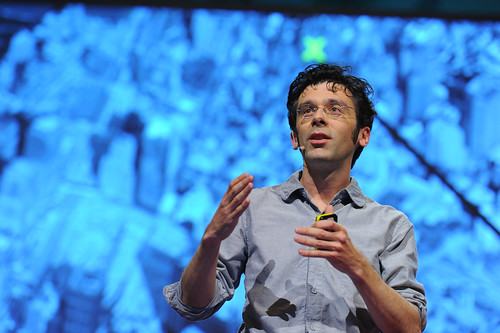
In the following TEDTalk presentation, Kevin Slavin argues that "we're living in a world designed for -- and increasingly controlled by -- algorithms. In this riveting talk, he shows how these complex computer programs determine espionage tactics, stock prices, movie scripts, and architecture. And he warns that we are writing code we can't understand, with implications we can't control."


I, for one, bow down to our maths overlords :)
Read More
Posted in math, technology, TEDTalks | No comments

Wednesday, 22 June 2011

Stuxnet: Anatomy of a Computer Virus

Posted on 07:01 by Unknown
No, it's Stuxnet, not Skynet... and you may have more reason to fear the former than the latter, at least if your name is not John Connor... Stuxnet seems to be the first super weapon made entirely out of code. Unlike conventional weapons, it doesn't directly kill anyone, but this 21st century virus has the potential to wreak havoc in a scale and depth that's simply unprecedented, partly because it is open source and therefore because it can mutate...

Governments and corporations may be afraid of Anonymous, but it's probably Stuxnet they should probably fear more, as the following animation demonstrates:


And if you want to learn more, Ralph Langner describes in the following TEDTalk presentation how his team cracked the code that revealed the target, purpose and implications of this virus on steroids:


And you use Norton? How cute :)
Read More
Posted in animation, corruption, privacy, technology, TEDTalks | No comments

Friday, 20 May 2011

Pendulum Waves

Posted on 07:48 by Unknown
Pendulums have been around for a very long time, at least since the 1st century, when the Chinese polymath Zhang Heng used one to build what is widely considered to be the very first seismometer in history.

The rigorous and scientific study of the properties of pendulums, however, didn't start until the 17th century, when Galileo took up the question. Undeniably, Galileo did some great and unprecedented work, but one can't help but wonder how much easier and productive his time could have been if he had thought up of this beautiful little experiment (without just becoming mesmerized by the optical illusion created by it):


And here is another beautiful version of the same basic idea.


And if you're curious about how seismometers, including Zhang Hen's, work, listen to this:


And if you want more on pendulums, I'll post an awesome entry on Foucault's pendulum soon. Stay tuned.
.
Read More
Posted in audio, Galileo, history, Optical illusion, physics, technology | No comments

Monday, 18 April 2011

David Christian - Big History

Posted on 07:14 by Unknown
I don't know if you paid attention during history class, but if you missed some of the highlights because you were sleeping or daydreaming, you're in luck because David Christian is here to tell the story of the universe, from the Big Bang to the internet in a mere 18 minutes.

As the video description mentions, "this is 'Big History': an enlightening, wide-angle look at complexity, life and humanity, set against our slim share of the cosmic timeline."


Check out more TEDTalks.
.
Read More
Posted in evolution, history, science, technology, TEDTalks | No comments

Thursday, 10 March 2011

Salman Khan - Using Video to Reinvent Education

Posted on 07:26 by Unknown
If you're an investment broker or an analyst at a hedge fund, there are probably a few things that are almost certainly true about you: you have craploads of money and the idea of doing something with real social value (and for free) is foreign to you :)

Fortunately, one such man, Salman Khan, decided that he'd rather make a meaningful contribution to the world instead of just rolling in dough, and created in the process Khan Academy, a non-profit organization with the goal of improving education by making it globally accessible to anyone, completely free of charge, and as he describes in the following TEDTalk presentation, that's only the beginning:


Check out some other radical (and fascinating) ideas on how to improve education.
.
Read More
Posted in education, technology, TEDTalks | No comments

Tuesday, 1 March 2011

Lord Robert Winston - How Science Changed Our World

Posted on 07:12 by Unknown
It is just not possible to deny the ubiquitous impact that science has had in all of our lives. The very fact that you're reading these lines on a computer or mobile phone (and are probably addicted to both) attests to the incredible power and influence that scientific innovation exerts on all of us, especially considering that much of the technology simply didn't exist until quite recently.

And while scientific blunders are inevitable, and controversies will always arise for good and bad reasons, the record speaks for itself: we are better off today than our ancestors were in the past.

So, what are the ten most important scientific discoveries or innovations of the past half a century? Well, any list will have some sort of subjective bias built into it, but Robert Winston has a few eclectic and deliciously fascinating nominations, from lasers so powerful they may finally help us finally produce nuclear fusion, to methods of contraception, the world wide intertubes, in vitro fertilization and embryonic stem cell research, microchips, functional magnetic resonance imaging that helps us see the brain in action, bionic prostheses and much, much more...


What else would you nominate?
.
Read More
Posted in documentary, environment, health, Lord Robert Winston, science, space, technology | No comments

Monday, 31 January 2011

Horizon - What is Reality?

Posted on 07:44 by Unknown
Ancient Greek philosophers like Parmenides, Zeno and Plato stumbled upon a radical discovery: the distinction between appearance and reality. If we are to ask the question of what reality is (and how we can know this), our best bet at finding some sort of answer would require that we delve deeply into science, mathematics and philosophy.

The following documentary explores some of the questions that are currently at the border between scientific inquiry and philosophical speculation: What are the basic constituents of the universe? How does quantum mechanics make sense? What's up with the double-slit experiment? Is mathematics the language in which the laws of the physical universe are written, or is the universe actually part of a mathematical structure? Do we live in a multi-dimensional universe, or are we simply the holographic projection of information forever trapped in the event horizon of some supermassive black hole? And why can't a guy get a date on a Saturday night? :)


I think the pony tail might help explain the mystery of the last question :)
Read More
Posted in documentary, Elegant Universe, math, philosophy, physics, science, technology | No comments

Wednesday, 15 December 2010

The Antikythera Mechanism - Recreated with Legos

Posted on 12:05 by Unknown
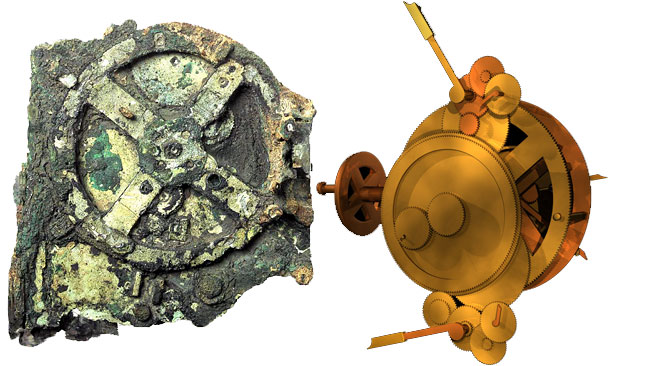
About a hundred years ago, a bunch of sponge divers doing their underwater thing stumbled upon an artifact whose complexity indicated it was some sort of calculating machine, but it would be decades before investigators would figure out exactly what this machine, now known as the Antikythera Mechanism, was designed to calculate: the cycles of the solar system, including the exact position of the sun, the moon and the planets. This information, of course, also helped it predict eclipses with uncanny accuracy.

Here is the insane part: the Antikythera Mechanism has been dated to the 2nd century B.C.! It would take the scientific revolution and almost two thousand years for technology to get this good again...

Anyway, Apple software engineer Andy Carol recently reconstructed the Antikythera Mechanism with one of the most sophisticated construction systems ever created: Legos :)


And for those of you who paid attention to the Ada Lovelace entry, here is a Babbage Difference Engine, also made of legos:


The next challenge is to build a machine with Jenga pieces :)
.
Read More
Posted in animation, history, math, space, technology | No comments

Thursday, 9 December 2010

Ada Lovelace - The Enchantress of Numbers

Posted on 07:31 by Unknown
Historically, women haven't always had access to formal education because we men are dicks, and we've rationalized our repression of women with the wildest and most inexcusable of excuses. But in those rare cases when individual women have had the fortune of receiving an education, they've certainly known how to leave their mark.

I don't know who my favorite female intellectual is (probably Émilie du Châtelet), but one who ranks in the top 10 would have to be Ada Lovelace (daughter of Lord Byron), and that's because the woman and her vision are simply remarkable.

For instance, she wrote the very first computer program... two hundred years before there were computers :)


Anyway, if you're interested in her personal life, you can listen to the lovely Stuff You Missed in History Class ladies:


If you want to get more into the programming and Babbage's analytical engine, perhaps the guys at Tech Stuff are more to your liking:


And for the more scholarly treatment, check out In Our Time, with Melvin Bragg.
.
Read More
Posted in animation, audio, biography, feminism, history, math, technology | No comments
Older Posts Home
Subscribe to: Posts (Atom)

Popular Posts

  • Obama and Romney Laugh It Up
    With the upcoming elections, things have been heated up for the past few months. And though not to the same level, both major contenders, as...
  • Diane Kelly - What We Didn't Know about Penis Anatomy
    Penises... they're great. In my case, we're best friends. I never leave home without mine. Do you? It may seem pretty obvious what t...
  • The Punishable Perils of Plagiarism
    As we've seen before (in a case in which a professor discovered a massive collective case of cheating ), academic dishonesty is a seriou...
  • Tsumanis 101
    Sometimes when it rains, it pours. Japan has been recently devastated by the accumulation of horrendous circumstances due to the earthquake ...
  • Doodling in Math - Spirals, Fibonacci and Plants - 3
    Ok, so now that you've learned how the beauty and elegance of the golden ratio and Fibonacci sequence are instantiated all over the natu...
  • Sean Carroll - The Case for Naturalism
    If you follow current events in the world of public intellectualism, you probably know that over the past few decades, and increasingly over...
  • Stephen Colbert - America Again: Re-Becoming the Greatness We Never Weren't
    Sorry for the sparse presence recently folks, but I've been buried under a mountain of work with the end of the semester. Last night, fo...
  • Daniel Dennett - How to Tell If You're an Atheist
    The human mind is both beautiful and frustrating. We have minds that can contemplate the meaning of infinity and consciousness, on the one h...
  • Super Monkey Collider Loses Funding
    Though the longitudinal study on whether multiple stab wounds may be harmful to monkeys is not yet complete, The Onion reports that the ec...
  • Miss USA Contestants on Evolution
    Let's be honest: beauty pageants are about how hot the contestants are. I won't pass judgment on whether this is morally acceptable ...

Categories

  • 3-minute philosophy (11)
  • 60 Second Adventures in Thought (8)
  • Alan Turing (3)
  • All Too Human (1)
  • amazing (6)
  • animals (25)
  • animation (77)
  • anthropology (4)
  • architecture (2)
  • Aristotle (13)
  • art (14)
  • atheism (41)
  • audio (21)
  • autism (2)
  • Ayaan Hirsi Ali (1)
  • Big Brother (4)
  • biography (9)
  • Bishop Berkeley (3)
  • Brainspotting (3)
  • Brian Cox (6)
  • Bryan Magee (1)
  • Carl Sagan (5)
  • Charles Darwin (9)
  • chemistry (6)
  • Christopher Hitchens (6)
  • cognitive science (5)
  • corruption (108)
  • Cosmos (3)
  • creationism (12)
  • Dan Ariely (1)
  • Daniel Dennett (4)
  • David Attenborough (3)
  • David Chalmers (1)
  • David Hume (17)
  • David Sloan Wilson (2)
  • debate (12)
  • Descartes (11)
  • dinosaurs (1)
  • documentary (45)
  • doodling in math (6)
  • E.O. Wilson (2)
  • economics (23)
  • education (43)
  • Einstein (11)
  • Elegant Universe (11)
  • Enemies of Reason (21)
  • environment (19)
  • Epicurus / Lucretius (1)
  • ethics (100)
  • evolution (55)
  • existentialism (13)
  • feminism (13)
  • Flying Spaghetti Monster (2)
  • Founding Fathers (13)
  • free speech (4)
  • free will (7)
  • Freud (1)
  • funny songs (12)
  • Galileo (6)
  • gay stuff (12)
  • geography (9)
  • George Carlin (2)
  • health (35)
  • Hegel (1)
  • Heidegger (1)
  • hilarious (163)
  • history (64)
  • Hobbes (8)
  • Inside Nature's Giants (6)
  • Jane Goodall (1)
  • Jim Al-Khalili (4)
  • John Locke (9)
  • John Searle (4)
  • Jon Stewart (48)
  • jurisprudence (8)
  • Kant (7)
  • Ken Miller (1)
  • Kierkegaard (2)
  • Kurt Vonnegut (1)
  • Large Hadron Collider (7)
  • Leibniz (5)
  • Leonardo da Vinci (1)
  • linguistics (11)
  • literature (25)
  • logic (60)
  • Lord Robert Winston (1)
  • magic (3)
  • Malcolm Gladwell (1)
  • Martin Luther King Jr. (2)
  • Marx (2)
  • Masters of Philosophy (19)
  • math (38)
  • Michael Faraday (2)
  • Michael Sandel (2)
  • Michael Shermer (1)
  • mind (34)
  • Mind control (1)
  • monkeys (8)
  • Monty Python (3)
  • movie (2)
  • music (7)
  • National Geographic (3)
  • Neil DeGrasse Tyson (7)
  • Newton (7)
  • Nietzsche (7)
  • Optical illusion (10)
  • Paradox (8)
  • Penn and Teller (1)
  • personal (5)
  • Peter Millican (10)
  • Peter Singer (7)
  • philosophy (111)
  • Philosophy: A Guide to Happiness (1)
  • physics (39)
  • Plato (7)
  • porn (7)
  • privacy (4)
  • problem of evil (4)
  • psychology (18)
  • public announcement (2)
  • racism (19)
  • religion (115)
  • Richard Dawkins (12)
  • Richard Feynman (7)
  • Ricky Gervais (1)
  • Robert Krulwich (1)
  • RSA Animate (16)
  • Sam Harris (3)
  • sartre (1)
  • science (79)
  • sex (19)
  • SNL (2)
  • Socrates (7)
  • space (32)
  • sports (4)
  • Stephen Colbert (40)
  • Stephen Fry (6)
  • Stephen Hawking (4)
  • Stephen J. Gould (1)
  • Steven Pinker (6)
  • Steven Weinberg (1)
  • technology (20)
  • TEDTalks (50)
  • The Human Sexes (4)
  • The Onion (24)
  • Tim Minchin (4)
  • time (5)
  • time lapse (10)
  • William Lane Craig (3)
  • Wittgenstein (3)

Blog Archive

  • ▼  2013 (49)
    • ▼  August (1)
      • The Terrors of Sleep Paralysis
    • ►  July (9)
    • ►  June (9)
    • ►  May (8)
    • ►  April (8)
    • ►  March (6)
    • ►  February (3)
    • ►  January (5)
  • ►  2012 (205)
    • ►  December (4)
    • ►  November (7)
    • ►  October (12)
    • ►  September (14)
    • ►  August (15)
    • ►  July (20)
    • ►  June (19)
    • ►  May (27)
    • ►  April (26)
    • ►  March (19)
    • ►  February (22)
    • ►  January (20)
  • ►  2011 (217)
    • ►  December (19)
    • ►  November (20)
    • ►  October (17)
    • ►  September (19)
    • ►  August (16)
    • ►  July (19)
    • ►  June (15)
    • ►  May (19)
    • ►  April (16)
    • ►  March (22)
    • ►  February (19)
    • ►  January (16)
  • ►  2010 (29)
    • ►  December (26)
    • ►  November (3)
Powered by Blogger.

About Me

Unknown
View my complete profile