PhilosophyMonkeyFranzKafka

  • Subscribe to our RSS feed.
  • Twitter
  • StumbleUpon
  • Reddit
  • Facebook
  • Digg

Friday, 2 August 2013

The Terrors of Sleep Paralysis

Posted on 07:40 by Unknown
Imagine living in medieval times, when weird and unexplained phenomena, especially those related to strange subjective experiences (such as feeling that you're being suffocated by demons in your sleep), were seen as indications and evidence of malevolent spiritual forces at work. In the famous Bull of 1484, for instance, Pope Innocent VIII (don't you love the irony of these names?) declared that:
members of both sexes do not avoid to have intercourse with evil angels, incubi and succubi, and that by their sorceries, and by their incantations, charms and conjurations, they suffocate, extinguish, and cause to perish the births of women [among many other evil things].
As Carl Sagan recounts in his book, The Demon Haunted World, "with this Bull, Innocent initiated the systematic accusation, torture, and execution of countless 'witches' all over Europe." This would lead to the publication of the infamous Malleus Maleficarum (the "Hammer of Witches"), one of the most vile, irrational, fearsome and cruel documents in all of human history. There's a chance even Hitler might have shuddered at it... Yay religion!?

Fortunately, and as usual, science has helped to shed some light on this otherwise dark and obscure phenomenon, saving people from medieval persecution and from forced mental institutionalization by discovering some of the underlying mechanisms at work, as well as their ubiquity because, believe it or not, it happens to most of us...


If you know someone whose life has been affected by the fear that they are being visited by probing aliens or haunted by evil spirits in the middle of the night, you might want to show them this video and assuage those feelings of fear and anguish...

And in case you are not aware of the distinction between an incubus and a succubus, and assuming these demons were not gay, incubi were 'seducers' of women, while succubi were 'seducers' of men, although if they're having their way with you while you're paralyzed, I'm not sure that would really count as 'seduction'...
Read More
Posted in animation, Carl Sagan, mind, Optical illusion, psychology, religion, RSA Animate, TEDTalks | No comments

Wednesday, 31 July 2013

Shooting an AK-47 Underwater

Posted on 07:36 by Unknown
Here in the US, we seem to be obsessed with guns, with our right to own them, and with the ridiculous fear that the government is going to try to take them away from us. Predictably, the people who are most vociferous on the issue are not exactly luminaries and scholars with a solid understanding of constitutional law and jurisprudence, which is really putting it mildly and generously...

But since this is a blog dedicated (for the most part) to sharing education and interesting ideas, why don't we take this obsession with guns to watch someone shoot an AK-47 underwater and, most importantly, to learn some fascinating principles of physics to understand what it is that we have just seen?


Explosions and physics... awesome!
Read More
Posted in education, physics, time lapse | No comments

Monday, 29 July 2013

John Searle - Our Shared Condition: Consciousness

Posted on 07:45 by Unknown
Studying consciousness is notoriously difficult, and until only the last couple of decades, very few intellectuals (apart from philosophers and psychologists) dared to even think about how to try to understand it. But with the rise of new disciplines and technologies, consciousness is starting to become the hot topic among academics. One of the problems, however, is that we don't yet quite have a theory about what consciousness is, and without an answer to that question, it's not always clear what disciplines and methods are most appropriate to use to study it.

In the following TEDTalk presentation, philosopher of mind John Searle (famous among other things for his Chinese room thought experiment) makes the case for studying consciousness, and for his own understanding, not so much of what consciousness is, but of how to approach the question. In the process, he shoots down some of the most popular objections to try to study consciousness scientifically, arguing that regardless of its ultimate ontological status, it's a biological process with multiple levels of description.


Read More
Posted in John Searle, mind, philosophy, TEDTalks | No comments

Wednesday, 24 July 2013

Brian Cox - Wonders of Life - Expanding Universe

Posted on 06:56 by Unknown
Our knowledge of the world comes from our experience of the world. And our experience is based on our sensory apparatus, but how do our senses work? What is it about the physical laws of the universe that make it possible for creatures like us to perceive anything at all?

In the following documentary, Brian Cox visits some interesting animals in the US (giant catfish, glowing scorpions, mantis shrimp and octopi, among others) to explore and understand how they, and we, are able to create mental representations of our environment through taste (chemicals), sound (air waves) and vision (light), and how it is that the gradual process of evolution through natural selection has slowly sculpted the amazing machinery of perception, by taking fish jaws, for instance, and slowly turned them into the ear bones that make hearing possible for you and me...


To catch that catfish, he didn't have to enlist the help of a scientist... he could have just told a redneck to go noodling :)
Read More
Posted in animals, Brian Cox, documentary, evolution, Optical illusion, physics, science | No comments

Monday, 22 July 2013

Flatland - Exploring Other Dimensions

Posted on 07:21 by Unknown
Plato's myth of the cave is an allegory that tries to make the point that there may be more to reality than meets the eye, that our experience is simply of a very limited and lowly aspect of reality. Given the knowledge and technology of the time, Plato's use of puppets and shadows in his ancient writing is brilliant in conveying the difference between the real and the apparent, but in the 1800's, Edwin Abbott took this idea much further, and in a way more rigorously and convincingly, as he was able to tell it through a creative exploration of mathematical space:

Compare the experience of a creature from three-dimensional space against one from a two-dimensional world. Easy, and completely reasonable to understand why the two-dimensional figure was skeptical of "more" dimensions, even if it was wrong, right? Well, apply the same reasoning to the difference between four-dimensional space and the three-dimensional space we're all used to. Wouldn't the reasoning you applied in the first case also apply to this one? And just like that time we were introduced to these ideas by the irreplaceable Carl Sagan, when he tried to show us the projection of a tesseract, here's a fun little animation to inspire your imagination and help you explore the beauty of mathematical space that can be understood by the mind even if it cannot be always perceived by the senses :)


Now, are there 'really' more dimensions than the three spatial ones we're used to or is this just a fancy mathematical abstraction? That's a topic for another discussion :p
Read More
Posted in animation, math, philosophy, Plato, RSA Animate | No comments

Thursday, 18 July 2013

Open Access Explained, PhD Comics Style

Posted on 06:12 by Unknown
As biological creatures, we are very adaptable. If we notice that some background condition remains relatively stable, we tend to ignore it after a while. On the one hand, this makes perfect sense, since we can't afford to devote all of our energy and attention resources to things that are unlikely to affect us in sudden ways. On the other hand, this makes us very susceptible to the status quo bias (failing to recognize better alternatives; failing to even acknowledge that there could be potentially better methods; perpetuating the current system as the solution to a problem that we often don't realize is the result of the very same system we use to 'fix' it; and even actively working against new possibilities, even while being fully cognizant of the problems and negative consequences associated with the systems currently implemented).

This problem is ubiquitous, and there are entire industries built upon the simple and great idea that for any given situation, there are probably better solutions than those that are currently being implemented. Unfortunately, some of these same industries, once they acquire a certain level of success and financial power, tend to re-affirm their own system instead of the original idea of constantly improving things. And if they have enough power and influence, they can actually become an impediment to improved efficiency. Professional academic journals, for all the wonderful work they do, have also fallen into this self-reinforcing pattern where their financial success has replaced the original idea for which they were created, and maybe it's time we start a dialogue to figure out how to make everyone better off...


Read More
Posted in animation, economics, education, science | No comments

Tuesday, 16 July 2013

Louis CK - If God Came Back...

Posted on 06:32 by Unknown
After God created the heavens and the earth, he thought to himself:
Let us make man in our image, after our likeness: and let him have dominion over the fish of the sea, and over the fowl of the air, and over the cattle, and over all the earth, and over every creeping thing that creepeth upon the earth.
Traditionally, this has been understood to mean that God created everything for the benefit of humans, and at the expense of everything and everyone else. Quite convenient for us, but what if what has been translated as "dominion" (in the sense of ownership) should really have been more accurately translated as "stewardship" (in the sense of "look after this for me till I come back, and don't fuck it up in the meantime!")?

Comedian Louis CK has a few thoughts on the subject...


I bet God is wondering how successfully He managed to make us in His image :p
Read More
Posted in corruption, environment, health, hilarious, religion | No comments

Tuesday, 9 July 2013

The Humanities - The Heart of the Matter

Posted on 13:50 by Unknown
We all like to make fun of English majors (and humanities students in general) from time to time (which is fine, no one should be exempt from a little mockery every now and then). The usual charge is that odious, unenlightened, ignorant, superficial, condescending question: what is a humanities major good for? Such a question implies that the only real value of an education is instrumental: what kind of job is it going to lead to? But this point of view gets it all backwards: money is good only insofar as it makes your life better and worth living, and living for the sake of money is to confuse the means for the end.

The slightly more respectable charge against the humanities, though still embarrassingly shallow, tends to come from those who espouse scientism, the idea that the only thing that matters is scientific knowledge. The reasoning in this case is that since the humanities do not lead to such knowledge, and the only kind of real knowledge is scientific, the humanities must be ultimately worthless. Now, I am perfectly well aware that, due particularly to the embarrassing intellectual and moral history associated with religious fundamentalism, many people are suspicious of questions of meaning, value, purpose and so on. And there really is something to be said for skepticism and suspicion with regard to these questions, but to deny the value of the humanities in general because one particular subject decided to take over the humanities for a long time, or even because some of its adherents tend to wax mystical and new-agey,  is to throw out the baby with the bathwater. If you wanted to get rid of a cockroach in your house, you wouldn't burn your house down, would you?

In any case, here are a bunch of people you may know and admire (actors, musicians, artists, film-makers, social commentators, documentary makers, writers, etc.) who have a little something to say about the personal and existential importance of the humanities, which is ultimately the heart of the matter...


"The sciences are the 'how,' and the humanities are the 'why.' -George Lucas.

With some reservations, I like that quote a lot.

Despite how much I like him, someone like Richard Dawkins might object and say that either why-questions are reducible to how-questions, or that why-questions are just silly questions. Of course, if you ask him WHY he thinks this, he would either tell you how the brain processes information (which is scientific, but irrelevant), or he would lead you to a question-begging infinite regress: if you ask him why that's a silly question, he would have to say, by his own reasoning: that's a silly question. But why is that a silly question? That's a silly question. But why is that a silly question? That's a silly question... The lesson, of course, is that at least some why questions are perfectly legitimate and meaningful, but if so, we're right back to having to agree that there must be some kind of value to the humanities...

And yes, sometimes there really can be reasonable disagreements about the difference between the humanities and social sciences, but still... :)


Read More
Posted in art, education, literature, music, philosophy | No comments

Wednesday, 3 July 2013

Franz Kafka - The Metamorphosis

Posted on 17:33 by Unknown
130 years ago today, in a world which no longer could be seriously understood as the effect or providence of the deliberate choice of a deity with a comprehensible, or even a coherent plan, one of the first men to viscerally understand and feel the essence of the absurdity of existence was born. His name was Franz Kafka. You may have heard of him...

Though not a philosopher himself, Kafka has become a literary icon and an inspiration to many philosophers, especially those of the existentialist persuasion. And to celebrate his birthday, here's one of his most famous and celebrated short works: The Metamorphosis


To get a sense of the absurdity of existence, you could hardly do better than stop by the Franz Kafka International Airport, previously described by The Onion as quite possibly the most alienating place in the world :)
Read More
Posted in existentialism, literature, philosophy | No comments

Malcolm Gradwell - Her Way

Posted on 07:37 by Unknown
What do you do when your best friend decides to marry someone who crushes his spirit, who loves him only on condition that he not be himself, who takes his sine qua non away from him, who makes him feel ashamed of the very things for which most people love him?

Well, if you're Malcolm Gladwell, apparently what you do is write a little ditty about it and perform it with your friends at the wedding reception :)


Most awkward wedding ever :)
Read More
Posted in funny songs, hilarious, Malcolm Gladwell, music | No comments

Sunday, 30 June 2013

Philosophers are no longer allowed at summer camp

Posted on 09:30 by Unknown
When it comes to the question of the metaphysics of diachronic personal identity (the question of whether you are the same person at different times), philosophers, such as John Locke, David Hume, Derek Parfit, David Lewis and others, have come up with a plethora of absolutely fascinating and disturbing thought experiments. The idea is that these intuition pumps should help us get clearer on the concept and its logical implications so we can test the coherence of various views. What they haven't always considered is how non-philosophers might react to these stories :)


Unfortunately, summer camp is not the only place we're banned from :(

Via: Saturday Morning Breakfast Cereal
Read More
Posted in 3-minute philosophy, hilarious, philosophy | No comments

Thursday, 27 June 2013

Filibustering to Abort the Abortion Bill

Posted on 12:17 by Unknown
When the Texas Senate wanted to pass a new abortion bill that would severely restrict abortion guidelines and ban abortions after 20 weeks, Senator Wendy Davis decided to literally stand up for women's right to make their own reproductive health choices by filibustering the bill for 13 hours in what has quickly become a national sensation that has galvanized liberal support from all corners of the nation.

Of course, conservatives are furious about her stance, and Governor Rick Perry (most likely afraid of losing his own office to her come next election), has decided to attack Davis on a personal level by going after her and her family. In addition, in one of his statements, Perry claimed that "in Texas, we value all life," apparently completely oblivious to the fact that on the very same day, his state had committed its 500th execution...

And just to give you a sense of the double-standards and dirty tricks some conservative opponents tend to use when approaching their core issues, here's what they tried to do with respect to the fact they saw that their bill wasn't going to pass:


The Daily Show with Jon Stewart
Get More: Daily Show Full Episodes,Indecision Political Humor,The Daily Show on Facebook

And although Davis ended up talking non-stop for about eleven hours, she can also be quite concise:


Read More
Posted in corruption, feminism, health, hilarious, Jon Stewart | No comments

Tuesday, 25 June 2013

The Punishable Perils of Plagiarism

Posted on 07:08 by Unknown
As we've seen before (in a case in which a professor discovered a massive collective case of cheating), academic dishonesty is a serious and growing problem. What most cheaters don't always realize, however (especially those who engage in plagiarism), is the paradoxical nature of cheating: those who need to do it are usually not clever enough to know how to do it well enough to get away with it, and those who could get away with it are smart enough not to need to do it...

To paraphrase something I read in a fascinating article on anosognosia a couple of years ago: if you're too stupid to cheat, you're probably too stupid to know you're too stupid to cheat... The irony, of course, is that if you think you're clever enough to get away with it, you probably don't belong to the clever category...

Now, while the following video disavows the existence of our agency, those of us who, willingly or unwillingly, work for the Department of Plagiarism Investigation are familiar with lots of different versions and variations of cheating, and the disadvantage of any one cheater is that he/she is competing against the accumulated knowledge our agency has collected since its inception a long, long time ago...

Here is just a small sample of the many ways (both laughable and frustrating) in which students think they can get away with plagiarized work:


Of course, we can't divulge all the methods we have for catching instances of plagiarism, but even if you don't care about education itself or the value of honest work, it's still in your own self-interest not to cheat because if you get caught... well, let's not go there...
Read More
Posted in animation, education, ethics, RSA Animate | No comments

Friday, 21 June 2013

The Examined Life

Posted on 06:43 by Unknown
While defending himself against his accusers (at least in Plato's Apology), Socrates uttered a sentence that has captured the essence of philosophy and that has reverberated through the centuries: "The unexamined life is not worth living."

More than two thousand years later, now that we live in a society that's technologically advanced and that has benefited from the lessons learned through science and history, is there any need to question our most basic presuppositions, to wonder whether we are on the path to achieving wisdom, to ask whether we are worthy human beings, to remove the mask of superficiality and peer into the depths of our being? You'd better believe it!

And to prove it, today we are showcasing the documentary The Examined Life, which consists of a few sections in which a bunch of philosophers (people like Cornel West, Peter Singer, Martha Nussbaum, Slavoj Zizek and others) talk for a few minutes about various issues that we may normally take for granted as settled. And as you'll see, these short discussions will make it painfully obvious that things aren't nearly as neat and settled as we tend to assume. And once the philosophical gadfly bites you, even though you might feel uncomfortable, you'll be better off than you were before since now at least you have some kind of idea about what's really going on. And it is in that realization and doubt that the seed of wisdom can be planted. The question then becomes whether you'll help cultivate it and grow...


We are featherless, two-legged, linguistically conscious creatures, born between urine and feces, whose body will one day be the culinary delight of terrestrial worms. That's us.
Awesome :)
Read More
Posted in documentary, ethics, Peter Singer, philosophy | No comments

Monday, 17 June 2013

Blowing the Whistle on Whistleblowers

Posted on 07:17 by Unknown
Whistleblowing and information leaks have been spearheading news headlines recently. Among the highest profile cases in America we've had Bradley Manning and, most recently, Edward Snowden. Many have jumped on the character assassination wagon, calling them traitors, cowards, and a lot of other things, even calling for their heads!, all of which tends to distract from the more pressing issue: the information leaked, what it tells us about the sources that were trying to keep it secret, and the implications going forward.

Directly or indirectly, both men did work for the government, so a case could potentially be made that they betrayed our government. Though I disagree with that position, I'm willing to grant it for the sake of argument. What they did not betray, however, is their country. They saw that the government was violating human rights, the constitution and the principles upon we always claim our nation was founded, and they decided to stand up to power so that we could rescue our country back from the forces that want to corrupt it for their own purposes. These men are American and moral heroes. Few have the courage to stand up and risk so much when it would be so much easier to just stay silent and look the other way, and now, in their time of need, we ought to stand by them and support them.

Yes, the information they revealed is shocking and damaging to our reputation, no doubt, but our reputation ought to be based who we are, not on what we hide. And claims regarding national security, at least in these two cases, have been completely fabricated or at least blown way out of proportion. Unlike the previous administration, which actually outed individual secret agents and put their lives at real risk (all in the name of politics, I might add), Manning and Snowden have leaked information about highly questionable programs and practices that have been institutionalized without having gone through the proper checks and balances (you know, pesky little things like the Constitution and such)...

But of course, how you feel about and refer to these folks depends on where you're coming from, as the hilarious Samantha Bee beautifully and succinctly shows:


The Daily Show with Jon Stewart
Get More: Daily Show Full Episodes,Indecision Political Humor,The Daily Show on Facebook

And just to give you a taste of the backward twilight zone world we seem to be living in, here's an example of those in (financial) power trying to silence those who report on their corruption by trying to turn the law on them! (and apparently without noticing the irony and contradiction):


The Daily Show with Jon Stewart
Get More: Daily Show Full Episodes,Indecision Political Humor,The Daily Show on Facebook

Ok, this is going to sound horrible, so be warned, but was it deliberate that the public relations spokesperson sort of looks like a piggy, to make it look like they sympathize with the plight of animals, or was it just an unfortunate and ironic coincidence?
Read More
Posted in animals, corruption, ethics, free speech, hilarious, Jon Stewart, jurisprudence | No comments

Monday, 10 June 2013

What Is Evolution and Natural Selection?

Posted on 06:14 by Unknown
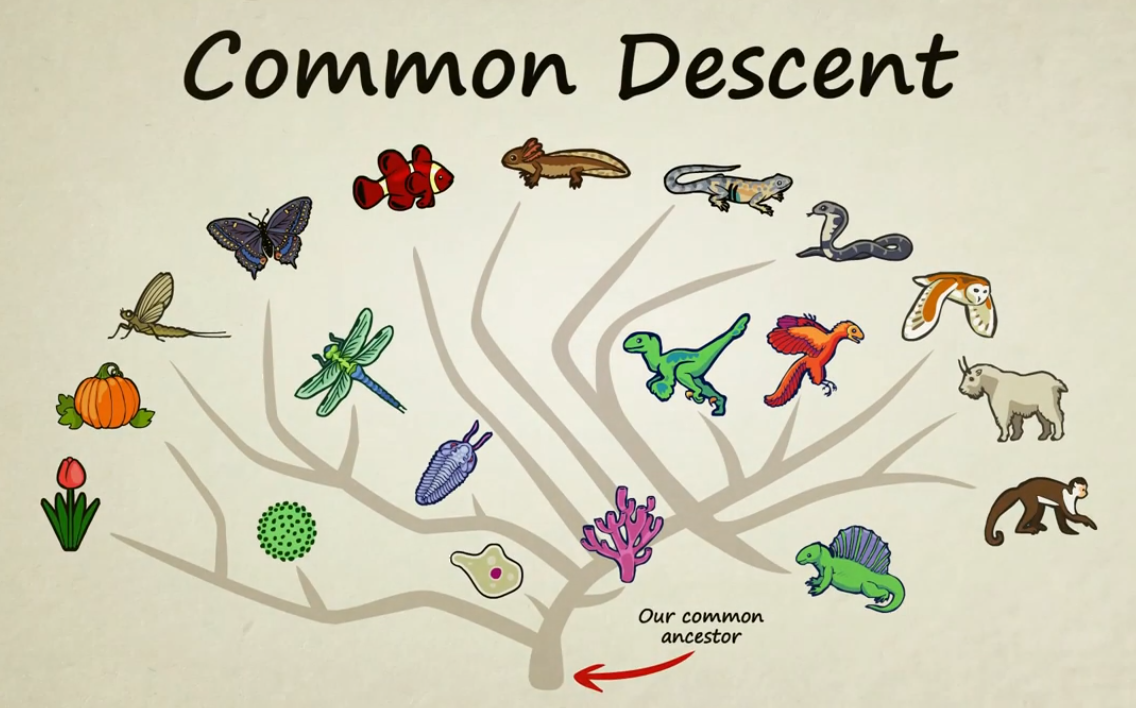
I don't know if it's by design or circumstance, but (apart from the religious and ideological elements) part of the resistance to evolution has to do with the fact that a number of related but distinct concepts are normally conflated with each other, so that if you disagree with one, you automatically assume that you must disagree with all of them. For instance, many people confuse natural selection with evolution, and think of them as interchangeable concepts, but the former is simply the most famous, and possibly main mechanism driving the fact of the latter.

And talking about facts, people also tend to confuse the fact of evolution with the theory of evolution. Evolution, the change in (gene) allele frequency in populations over the span of multiple generations, is a fact that even the most hard-core creationists can't deny with a straight face (after all, you are not identical to either of your parents, nor to your own children). The theory of evolution is a scientific model (and by far the most successful account so far) to explain, understand and make sense of the fact of evolution (why it happens). And to bring it all full-circle, the theory makes use of various mechanisms, most notably, though not exclusively, natural selection. So yeah, I can understand why some people might get a little confused...

But if that seems needlessly abstract, here's a little animation to clarify what evolution is:


Having established that, the next point to touch on is the consequences of evolution and what it implies about us and our place in the grand scheme of things. Many people tend to disagree with evolution, not because it's not supported by more evidence than we know what to do with or because it doesn't make sense but because, as a kind of universal acid, it tends to undermine our inflated egos.

We like to think of ourselves as fallen angels, ignited by a kind of divine spark, but it may be more accurate to say that we are risen apes, and that we can trace our inglorious genealogical lineage all the way back to pond scum. Then again, how is that any worse than thinking we come from dust?

But before we consider the logical implications of this idea, here's a little lesson, again clearly articulated, explaining the basic logic behind the mechanism of natural selection:


And here's why the idea of 'intelligent design' is undermined by our observation of fossils and the massive number of extinct species: evolution is a 'blind watchmaker,' a tinkerer (not a designer) whose success is acquired by the death and destruction of all those experiments that ended up failing.
Read More
Posted in animation, evolution, science | No comments

Saturday, 8 June 2013

Buy Starschmucks, Attack God?

Posted on 07:15 by Unknown
Apparently evangelical Christian and right-wing conservative 'historian' David Barton and I have something in common: we kind of hate Starschmucks. Our reasons, however, differ. My antagonism is based on the condescending pretentiousness of the brand and many of its 'baristas,' and on the fact they have driven many humble mom-n-pop coffee shops into the ground. Barton's problem, however, is that StarBucks believes in marriage equality.

It's typical of right-wing conservative fundamentalist Christians like Barton to be obsessed with questions of sexuality (especially other people's) while ignoring questions of poverty, social justice and loving our neighbors. After all, given everything Jesus said about homosexuality... oh wait, he never said a word about it! He only wasted his time trying to make people kinder and more accepting and forgiving of others...

In any case, while the following analysis by The Young Turks commits a bunch of logical mistakes of its own, they do manage to drive home the point regarding the arbitrary double-standard on which most religion-based objections to homosexuality are based and what the consequences of taking their own reasoning seriously entails...


And I've never understood this, but how exactly do beards have corners???
Read More
Posted in corruption, ethics, gay stuff, religion | No comments

Thursday, 6 June 2013

Hunters Are Pussies

Posted on 06:56 by Unknown
There, I said it. You have probably seen what hunters like to do, right? Once they've killed some "game," they like to take pictures of themselves next to the dead carcass before mounting it as a trophy on their walls for the world to see and admire. Future generations are going to think of us the way we think today about slave owners: as a bunch of ignorant assholes...

But here's the thing: this wasn't a fair fight. In fact, it wasn't a fight at all. The poor animal got ambushed and killed before it could have any time to protect itself, and the wimpy but boastful "predator" was hundreds of yards away, taking comfortable advantage of a weapon that makes him feel like a "man" while simultaneously negating that manhood by placing him completely outside of any real danger and discomfort.

And as Stephen Colbert reports, to add insult to injury, they're also getting lazier...


The Colbert Report
Get More: Colbert Report Full Episodes,Indecision Political Humor,Video Archive

If you want to hunt and be a real man, leave your rifle behind, grab a couple of knives and go fight the beast head-on. Let the best fighter win...

But let's keep it real, here's what's probably going to happen:


Q.E.D.
Read More
Posted in ethics, hilarious, Stephen Colbert, technology | No comments

Tuesday, 4 June 2013

Daniel Dennett - Intuition Pumps and Other Tools for Thinking

Posted on 07:27 by Unknown
After a long and distinguished career in philosophy of mind, cognitive science, evolution and artificial intelligence, philosopher Daniel Dennett has picked up a number of mental tools along the way to help him reason his way through various interesting and thought-provoking conceptual puzzles and questions.

And nice guy that he is, he has taken the time to write a whole book about them to share with the rest of the world. These intuition pumps can be deployed to deal with a myriad of different scenarios, from the mundane to the highly abstract and philosophical, and no matter what kind of work you do or what kind of circles you run in, chances are these tools are going to make your life easier and more interesting.


Read More
Posted in Daniel Dennett, logic, philosophy | No comments

Friday, 31 May 2013

Walt Whitman - Song of Myself

Posted on 08:51 by Unknown
The poetic style of free verse was born from the iconoclastic mind of Walt Whitman, an American poet who embodied the concepts of individualism and defiance to his core.

On the one hand, the invention of free verse made it possible for geniuses such as William Butler Yeats, T.S. Elliot, Wallace Stevens and Thomas Hardy to explore and harvest a fascinating literary space previously uncharted. On the other hand, and because of its apparent lack of constraint, free style may have also marked the slow death and collapse of poetry as a fine art: just look at much of what passes for "poetry" today.

However you may feel about free verse, though, it is hard to deny Walt Whitman's  brilliance, which we get to celebrate today (this being his birthday) with a short excerpt from his famous poem "Song of Myself," read by none other than Darth Va... I mean James Earl Jones


Go ahead and contradict yourself, Walt, it's your birthday :)
Read More
Posted in audio, literature | No comments
Newer Posts Older Posts Home
Subscribe to: Posts (Atom)

Popular Posts

  • Report: U.S. Kids Get Majority of Antibiotics from McDonald's
    And here we've been complaining about our lack of a healthcare system that attends to the medical needs of the poor:) Check out more hil...
  • Election Results in a Beautiful Animation
    I don't know if you heard, but here in the ol' U.S. of A. we just had an election this Tuesday. You know, just trying to choose who ...
  • Unhate
    Contrary to what the majority of people all over the world believe, I'm pretty sure this is the only life we will ever know. To some, th...
  • Peter Singer vs. Don Marquis - Abortion Debate
    Outside of philosophical circles, I'm sorry to say, arguments concerning the issue of abortion, for and against it, usually take place w...
  • Christopher Hitchens - Philosophy and Booze
    If you're familiar with the late Christopher Hitchens, you probably know that besides being a prolific writer, social commentator, publi...
  • Steven Pinker on Taboos, Political Correctness and Dissent
    It's Steven Pinker... he's got things to say, and you already know that whether you agree with his views or not, he's always int...
  • Daniel Dennett - How to Tell If You're an Atheist
    The human mind is both beautiful and frustrating. We have minds that can contemplate the meaning of infinity and consciousness, on the one h...
  • Cameron Diaz Flirts with Sir David Attenborough
    If you've been spoiled by multiple BBC documentaries narrated by Sir David Attenborough, as I have, then you've probably experience...
  • Stephen Colbert - America Again: Re-Becoming the Greatness We Never Weren't
    Sorry for the sparse presence recently folks, but I've been buried under a mountain of work with the end of the semester. Last night, fo...
  • The Scanner's Prayer
    If there is one thing most of us think is private, it's our thoughts. And the only time we tend to be okay with our private thoughts bei...

Categories

  • 3-minute philosophy (11)
  • 60 Second Adventures in Thought (8)
  • Alan Turing (3)
  • All Too Human (1)
  • amazing (6)
  • animals (25)
  • animation (77)
  • anthropology (4)
  • architecture (2)
  • Aristotle (13)
  • art (14)
  • atheism (41)
  • audio (21)
  • autism (2)
  • Ayaan Hirsi Ali (1)
  • Big Brother (4)
  • biography (9)
  • Bishop Berkeley (3)
  • Brainspotting (3)
  • Brian Cox (6)
  • Bryan Magee (1)
  • Carl Sagan (5)
  • Charles Darwin (9)
  • chemistry (6)
  • Christopher Hitchens (6)
  • cognitive science (5)
  • corruption (108)
  • Cosmos (3)
  • creationism (12)
  • Dan Ariely (1)
  • Daniel Dennett (4)
  • David Attenborough (3)
  • David Chalmers (1)
  • David Hume (17)
  • David Sloan Wilson (2)
  • debate (12)
  • Descartes (11)
  • dinosaurs (1)
  • documentary (45)
  • doodling in math (6)
  • E.O. Wilson (2)
  • economics (23)
  • education (43)
  • Einstein (11)
  • Elegant Universe (11)
  • Enemies of Reason (21)
  • environment (19)
  • Epicurus / Lucretius (1)
  • ethics (100)
  • evolution (55)
  • existentialism (13)
  • feminism (13)
  • Flying Spaghetti Monster (2)
  • Founding Fathers (13)
  • free speech (4)
  • free will (7)
  • Freud (1)
  • funny songs (12)
  • Galileo (6)
  • gay stuff (12)
  • geography (9)
  • George Carlin (2)
  • health (35)
  • Hegel (1)
  • Heidegger (1)
  • hilarious (163)
  • history (64)
  • Hobbes (8)
  • Inside Nature's Giants (6)
  • Jane Goodall (1)
  • Jim Al-Khalili (4)
  • John Locke (9)
  • John Searle (4)
  • Jon Stewart (48)
  • jurisprudence (8)
  • Kant (7)
  • Ken Miller (1)
  • Kierkegaard (2)
  • Kurt Vonnegut (1)
  • Large Hadron Collider (7)
  • Leibniz (5)
  • Leonardo da Vinci (1)
  • linguistics (11)
  • literature (25)
  • logic (60)
  • Lord Robert Winston (1)
  • magic (3)
  • Malcolm Gladwell (1)
  • Martin Luther King Jr. (2)
  • Marx (2)
  • Masters of Philosophy (19)
  • math (38)
  • Michael Faraday (2)
  • Michael Sandel (2)
  • Michael Shermer (1)
  • mind (34)
  • Mind control (1)
  • monkeys (8)
  • Monty Python (3)
  • movie (2)
  • music (7)
  • National Geographic (3)
  • Neil DeGrasse Tyson (7)
  • Newton (7)
  • Nietzsche (7)
  • Optical illusion (10)
  • Paradox (8)
  • Penn and Teller (1)
  • personal (5)
  • Peter Millican (10)
  • Peter Singer (7)
  • philosophy (111)
  • Philosophy: A Guide to Happiness (1)
  • physics (39)
  • Plato (7)
  • porn (7)
  • privacy (4)
  • problem of evil (4)
  • psychology (18)
  • public announcement (2)
  • racism (19)
  • religion (115)
  • Richard Dawkins (12)
  • Richard Feynman (7)
  • Ricky Gervais (1)
  • Robert Krulwich (1)
  • RSA Animate (16)
  • Sam Harris (3)
  • sartre (1)
  • science (79)
  • sex (19)
  • SNL (2)
  • Socrates (7)
  • space (32)
  • sports (4)
  • Stephen Colbert (40)
  • Stephen Fry (6)
  • Stephen Hawking (4)
  • Stephen J. Gould (1)
  • Steven Pinker (6)
  • Steven Weinberg (1)
  • technology (20)
  • TEDTalks (50)
  • The Human Sexes (4)
  • The Onion (24)
  • Tim Minchin (4)
  • time (5)
  • time lapse (10)
  • William Lane Craig (3)
  • Wittgenstein (3)

Blog Archive

  • ▼  2013 (49)
    • ▼  August (1)
      • The Terrors of Sleep Paralysis
    • ►  July (9)
    • ►  June (9)
    • ►  May (8)
    • ►  April (8)
    • ►  March (6)
    • ►  February (3)
    • ►  January (5)
  • ►  2012 (205)
    • ►  December (4)
    • ►  November (7)
    • ►  October (12)
    • ►  September (14)
    • ►  August (15)
    • ►  July (20)
    • ►  June (19)
    • ►  May (27)
    • ►  April (26)
    • ►  March (19)
    • ►  February (22)
    • ►  January (20)
  • ►  2011 (217)
    • ►  December (19)
    • ►  November (20)
    • ►  October (17)
    • ►  September (19)
    • ►  August (16)
    • ►  July (19)
    • ►  June (15)
    • ►  May (19)
    • ►  April (16)
    • ►  March (22)
    • ►  February (19)
    • ►  January (16)
  • ►  2010 (29)
    • ►  December (26)
    • ►  November (3)
Powered by Blogger.

About Me

Unknown
View my complete profile